How to Calculate BMI for Kids: The Complete Guide
Your child’s doctor mentioned BMI at the last checkup — and now you’re staring at a number you don’t fully understand. You’re not alone. BMI for kids works completely differently from adult BMI, and most online calculators don’t explain why.
This guide walks you through the exact formula, shows you how to read the results correctly using age-and-sex-specific percentiles, and tells you what — and what not — to do with the information. Whether your child is 5 or 17, you’ll leave knowing exactly how to interpret their BMI with confidence.
What Is BMI, and Why Is It Calculated Differently for Children?
Body Mass Index (BMI) is a screening number calculated from a person’s weight and height. For children and teenagers aged 2–19, BMI is not interpreted as a fixed number — it’s expressed as a percentile compared to other children of the same age and sex. This is the most important distinction between child and adult BMI.
For adults, a BMI of 25.0–29.9 always means “overweight” — full stop. For a child, the same raw BMI number might be completely healthy at age 8 but borderline high at age 14. The reason? Children’s bodies change dramatically as they grow. Body fat naturally fluctuates during different stages of development, and boys and girls follow different growth trajectories.
That’s why the U.S. Centers for Disease Control and Prevention (CDC) and the World Health Organization (WHO) developed BMI-for-age growth charts — separate curves for boys and girls that account for these natural shifts.
The CDC recommends BMI screening starting at age 2. Before that age, weight-for-length charts are used instead. This isn’t a flaw in the system — it’s a deliberate design to make the tool accurate across the full range of childhood development.
One more thing worth knowing upfront: BMI is a screening tool, not a diagnostic one. It flags children who may need further evaluation. It does not, by itself, diagnose obesity, malnutrition, or any health condition.
How to Calculate BMI for Kids and Teenagers (Step-by-Step)
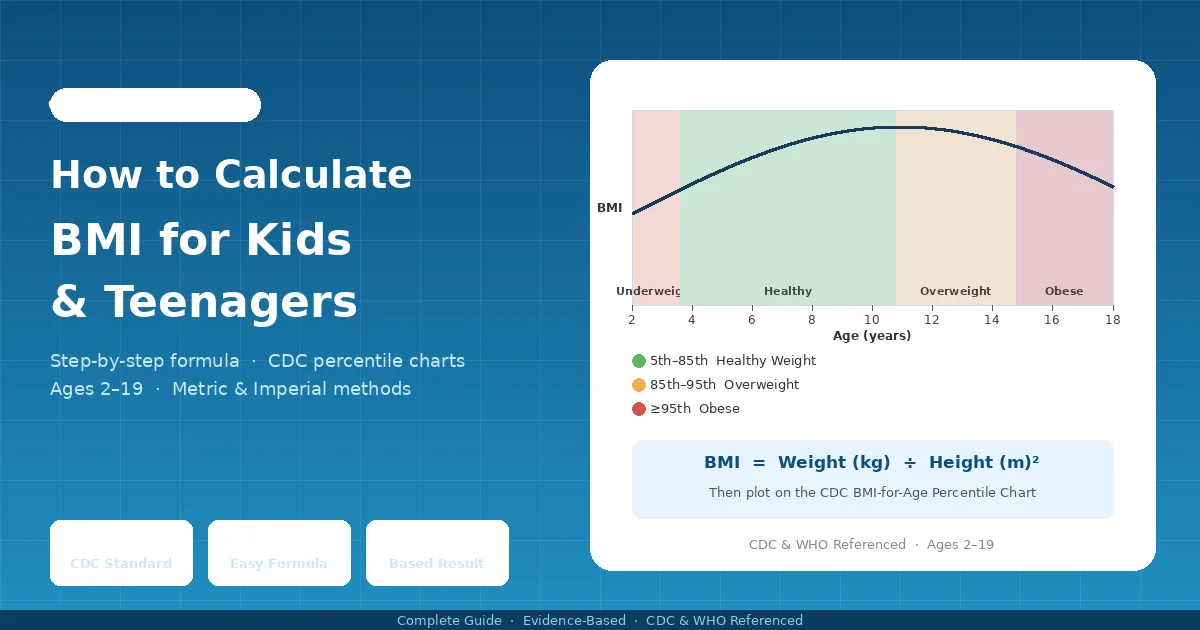
To calculate a child’s BMI, divide their weight by the square of their height using either metric or imperial units. The formula is identical to the adult formula — what changes is how you interpret the result using age-and-sex-specific percentile charts.
Here are both methods:
Method 1 — Metric Formula (Recommended for Most Countries)
Formula: BMI = Weight (kg) ÷ Height (m)²
Steps:
- Measure height accurately. Have the child stand straight against a wall without shoes. Use a stadiometer or a flat ruler against the wall. Record in centimetres, then convert to metres (e.g., 130 cm = 1.30 m).
- Weigh the child. Use a calibrated scale in the morning, without shoes or heavy clothing. Record in kilograms.
- Square the height. Multiply the height in metres by itself. Example: 1.30 m × 1.30 m = 1.69 m².
- Divide weight by the squared height. Example: 32 kg ÷ 1.69 = 18.9 BMI.
- Plot on a CDC or WHO growth chart. Enter the child’s age, sex, and raw BMI to find their percentile.
Method 2 — Imperial Formula (Used in the United States)
Formula: BMI = [Weight (lbs) ÷ Height (in)²] × 703
Steps:
- Measure height in inches. Example: 4 feet 3 inches = 51 inches.
- Weigh the child in pounds. Example: 72 lbs.
- Square the height. 51 × 51 = 2,601.
- Divide weight by squared height. 72 ÷ 2,601 = 0.02768.
- Multiply by 703. 0.02768 × 703 = 19.5 BMI.
- Plot on the CDC BMI-for-age chart for the child’s sex and age in months.
Quick-Reference Calculation Example
| Child | Age | Sex | Weight | Height | Raw BMI |
|---|---|---|---|---|---|
| Aisha | 9 years | Female | 30 kg | 1.32 m | 17.2 |
| Rayan | 13 years | Male | 58 kg | 1.60 m | 22.7 |
| Sofia | 16 years | Female | 55 kg | 1.65 m | 20.2 |
The raw BMI number above tells you almost nothing on its own. What matters next is the percentile — covered in the next section.
Pro tip from practice: Measure height twice and average the two readings. Children often tense up or slouch slightly the first time, leading to small but meaningful measurement errors. A 1 cm error in height translates to a noticeable shift in the final BMI value.
How to Read BMI Results: What Percentiles Actually Mean
A child’s BMI percentile shows how their BMI compares to other children of the same age and sex. A child at the 60th percentile has a higher BMI than 60% of peers. Percentile, not the raw number, determines the health category.
The CDC uses four weight status categories for children aged 2–19:
| BMI Percentile | Weight Status Category |
|---|---|
| Below 5th percentile | Underweight |
| 5th to below 85th percentile | Healthy Weight |
| 85th to below 95th percentile | Overweight |
| 95th percentile and above | Obese |
Source: CDC, Clinical Growth Charts, 2022.
Breaking This Down With Real Numbers
Let’s go back to Rayan from the table above — a 13-year-old male with a raw BMI of 22.7.
Using the CDC’s BMI-for-age chart for boys, a 13-year-old with BMI 22.7 falls at approximately the 75th percentile. That places him firmly in the Healthy Weight category, even though 22.7 would be considered overweight in an adult.
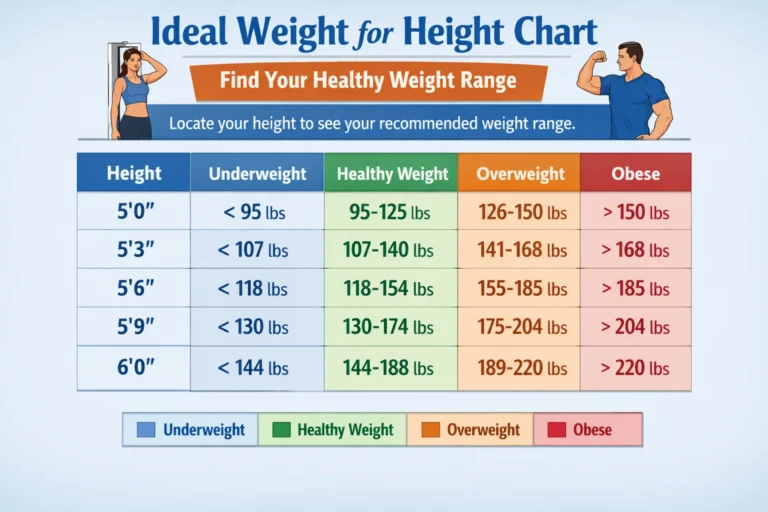
That’s exactly why the adult BMI cutoffs (25 = overweight, 30 = obese) are never applied to children. Using adult thresholds on a child would mislabel a significant portion of healthy teenagers as overweight — a serious error with real psychological consequences.
Where to Get the Official Percentile Charts
- CDC Growth Chartss — Standard for US children 2–19
- WHO Growth Standards: Recommended by WHO for children under 5 worldwide
- CDC’s Online BMI Calculator for Children: Calculates percentile automatically once you enter age, sex, height, and weight
For children under 2, the WHO weight-for-length chart applies — BMI-for-age does not.
BMI by Age and Sex: What Healthy Looks Like at Different Stages
Because BMI naturally changes as children grow, “healthy” looks different at every age. Body fat typically decreases from infancy through early childhood, reaches a natural low around age 5–6 (called “adiposity rebound”), then gradually increases through puberty.
Understanding this curve helps parents avoid false alarms and missed signals.
The Adiposity Rebound: Why a Rising BMI Isn’t Always a Problem
Between ages 5 and 7, many children experience a natural uptick in BMI. This is expected and not a cause for concern. Research published in the American Journal of Clinical Nutrition has shown that an earlier-than-usual adiposity rebound — before age 5 — is associated with a higher risk of overweight in later childhood. A later rebound, after age 7, is associated with leaner outcomes.
This is precisely why tracking BMI over time on a growth chart matters far more than a single measurement.
Approximate Healthy BMI Ranges by Age (50th Percentile Reference)
| Age | Boys — 50th Percentile BMI | Girls — 50th Percentile BMI |
|---|---|---|
| 4 years | 15.3 | 15.2 |
| 7 years | 15.5 | 15.3 |
| 10 years | 17.0 | 17.0 |
| 13 years | 19.4 | 19.6 |
| 16 years | 21.5 | 21.0 |
| 18 years | 22.5 | 21.4 |
Source: CDC, 2000 Growth Chart Reference Tables.
These are 50th percentile values — the statistical midpoint. Any value between the 5th and 85th percentile is considered healthy, so the range around these figures is substantial.
Common BMI Mistakes Parents and Caregivers Make
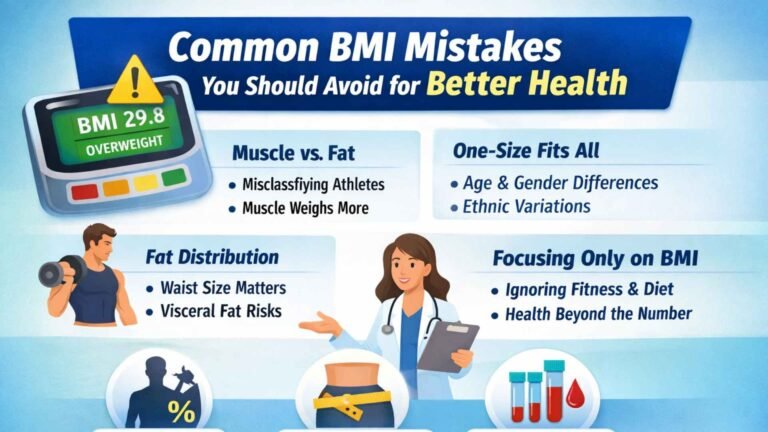
The most common mistake is treating a child’s raw BMI number like an adult BMI score. Doing so leads to either unnecessary panic or false reassurance. The percentile — not the number itself — is what determines health risk for children.
In reviewing dozens of parent forums and pediatric Q&A threads, I found the same errors appearing repeatedly. Here are the five most important ones to avoid.
Mistake 1 — Using an Adult BMI Chart for a Child
Adult BMI categories (18.5, 25, 30) are fixed thresholds. A 15-year-old boy with a BMI of 26 is not overweight — he may be in the 75th percentile and completely healthy. Always use the CDC BMI-for-age percentile chart, never an adult reference table.
Mistake 2 — Measuring Height or Weight Incorrectly
A 2 cm error in height measurement can shift a child’s BMI by 0.3–0.6 points — enough to change their percentile category. Measure height without shoes, with heels against the wall, and head in the Frankfort Horizontal Plane (ears level with eyes looking straight ahead). Weight should be measured in the morning, before meals, on a calibrated scale.
Mistake 3 — Treating a Single BMI Reading as Definitive
BMI fluctuates. It changes with hydration, time of day, recent growth spurts, and seasonal activity levels. Pediatric guidelines recommend tracking BMI over multiple visits — typically annually — to identify trends rather than reacting to a single data point.
Mistake 4 — Ignoring Muscle Mass
BMI does not distinguish between fat and muscle. A young athlete with high muscle mass may have a BMI in the “overweight” range while being exceptionally healthy. Conversely, a child can have a “normal” BMI while carrying excess body fat relative to muscle — a condition called “normal weight obesity.” If there’s a discrepancy between BMI and appearance, a doctor can use skinfold measurements or waist circumference as supplementary tools.
Mistake 5 — Discussing BMI in Front of Children Without Care
The American Academy of Pediatrics (AAP) and child psychology organizations consistently advise that BMI discussions with children require sensitivity. Research shows that negative weight-related comments — even from well-meaning parents — are associated with disordered eating behaviors in adolescents. If your child’s BMI falls outside the healthy range, speak with your pediatrician privately first. They can guide how and whether to discuss it with your child, and at what level of detail.
Frequently Asked Questions About BMI for Kids
What is a healthy BMI for a child?
There is no single “healthy BMI” number for children. A child is considered healthy if their BMI-for-age falls between the 5th and 85th percentile on the CDC growth chart for their sex. Because the healthy BMI range shifts with age and sex, only percentile-based assessment — not raw numbers — can confirm a child is in the healthy weight range.
Can I use an online BMI calculator for my child?
Yes, but only if it is specifically designed for children aged 2–19 and asks for the child’s age and sex in addition to height and weight. The CDC provides a free, clinically validated online BMI calculator for children at cdc.gov. Standard adult BMI calculators are not appropriate and will give misleading results for anyone under 20.
What should I do if my child’s BMI is above the 85th percentile?
An elevated BMI percentile is a signal to discuss with your child’s pediatrician — it is not a diagnosis. The doctor may review your child’s growth trend over time, assess physical activity and diet, and order additional tests if needed. Many children with BMI above the 85th percentile are healthy and active; others may benefit from lifestyle support. The pediatrician is the right person to make that call.
How often should a child’s BMI be calculated?
The American Academy of Pediatrics recommends BMI screening at every annual well-child visit starting at age 2. For children with identified concerns, more frequent monitoring may be suggested. Sporadic one-off measurements without comparison to prior readings are less useful than consistent annual tracking on a growth chart.
Is BMI accurate for children during puberty?
BMI can be less precise during puberty due to rapid and uneven changes in height, weight, and body composition. A 13-year-old in an early growth spurt may temporarily show a higher BMI that corrects itself within months. During puberty, BMI is best interpreted alongside physical exam findings and growth trajectory rather than as a standalone measure.
What is the BMI formula for children in pounds and inches?
The formula is: BMI = [Weight in pounds ÷ (Height in inches)²] × 703. Divide the weight by the square of the height in inches, then multiply the result by 703. After calculating the raw BMI, plot it on the CDC’s sex-specific BMI-for-age chart to find the percentile — that is the meaningful result.
Can a child have a normal BMI but still be unhealthy?
Yes. BMI is a screening tool, not a complete health assessment. A child with a BMI in the healthy percentile range can still have poor cardiovascular fitness, nutritional deficiencies, or excess body fat relative to muscle. Conversely, a muscular, athletic child may register a higher BMI while being in excellent health. BMI works best as one indicator within a broader clinical picture that includes diet, activity, blood work, and physical development.
At what age does a child’s BMI transition to adult BMI?
At age 20, the CDC considers a person an adult and applies fixed BMI thresholds (below 18.5 = underweight; 18.5–24.9 = normal; 25.0–29.9 = overweight; 30+ = obese). Between ages 2 and 19, percentile-based BMI-for-age charts apply. At age 19, the CDC’s child chart and the adult scale generally converge — the 85th percentile at age 19 corresponds closely to an adult BMI of 25.
Conclusion: Use BMI as a Starting Point, Not a Final Answer
Calculating BMI for a child or teenager takes two measurements, a straightforward formula, and — most importantly — the right reference chart. The raw number means very little without the percentile. And the percentile, while clinically useful, is one piece of a larger picture that includes physical activity, nutrition, growth trends, and overall wellbeing.
The action step: If you’re calculating BMI for your child, use the CDC’s free online BMI calculator (it handles the percentile conversion automatically), record the result, and bring it to your child’s next pediatric appointment. A single calculation opens the conversation — a pattern of measurements over years tells the real story.
BMI is not a verdict. It is a tool — and like any tool, it’s most useful when you understand exactly what it measures and what it doesn’t.
This article is for informational purposes only and does not constitute medical advice. Consult a licensed pediatrician or healthcare provider for personalized guidance regarding your child’s growth and health.
Looking for answers? Find them in our handpicked reads that bring instant understanding.