Normal BMI vs Ideal Weight: The Complete 2026 Guide
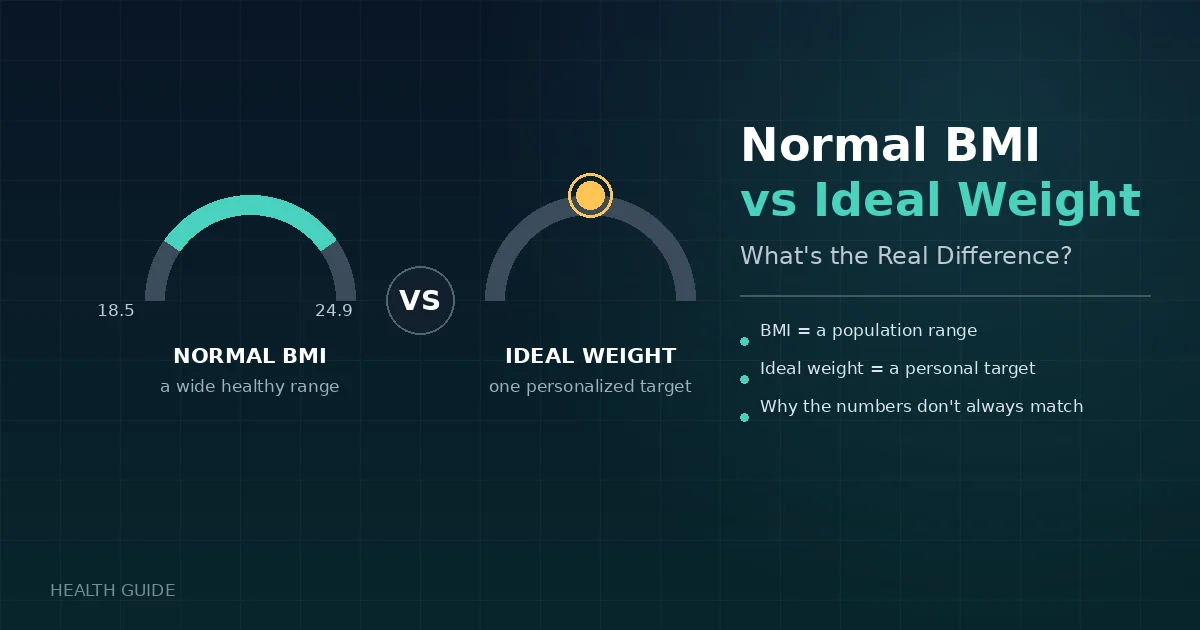
A “normal” BMI and your “ideal weight” sound like the same thing. They aren’t. BMI is a population-level screening number based only on height and weight. Ideal weight tries to estimate the weight that’s actually healthiest for your body — accounting for frame size, muscle mass, age, and sex. This guide breaks down exactly how the two are calculated, where they contradict each other, and which one you should actually pay attention to.
What Is BMI and How Is It Calculated?
BMI (Body Mass Index) is your weight in kilograms divided by your height in meters squared. It’s a quick screening tool — not a diagnosis — that sorts adults into underweight, normal weight, overweight, or obese categories based on a single ratio.
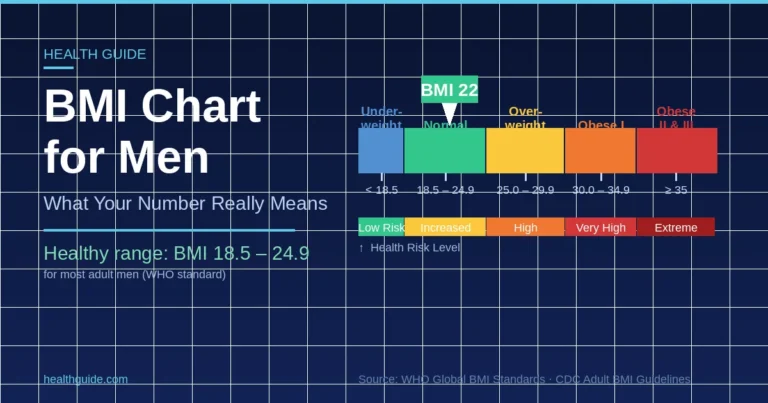
The formula is simple: BMI = weight (kg) ÷ height (m)². If you’re using pounds and inches, multiply your weight by 703, then divide by your height in inches, and divide again by your height in inches. A BMI between 18.5 and 25 kg/m² is generally classified as normal weight, while a BMI under 18.5 is considered underweight, 25 to 29.9 is overweight, and 30 or above is obese.
I’ve pulled BMI charts for clients for over a decade, and the first thing I tell people is this: BMI was never designed to measure you specifically. It was developed by Belgian mathematician and statistician Adolphe Quetelet between 1830 and 1850, originally as a way to study the “average man” across a population — not as a personal health metric. The modern term “body mass index” was only coined in 1972, decades after Quetelet’s original work.
Here’s the standard adult BMI classification table used by the CDC and WHO:
| BMI Range | Category |
|---|---|
| Below 18.5 | Underweight |
| 18.5 – 24.9 | Normal / Healthy weight |
| 25.0 – 29.9 | Overweight |
| 30.0 and above | Obese |
BMI is useful because it’s fast, free, and requires no special equipment. That’s exactly why doctors, insurers, and public health agencies still use it as a first-pass screening tool. But a single ratio can’t tell the difference between 20 pounds of muscle and 20 pounds of fat — and that’s where the gap with “ideal weight” starts to show up.
What Is Ideal Weight and How Does It Differ From BMI?
Ideal weight is a personalized estimate of the healthiest weight for your specific height, sex, and frame size — not just a height-to-weight ratio. Unlike BMI, ideal weight formulas were originally built for medical dosing calculations and try to account for individual body structure rather than population averages.
The most common ideal weight formulas are:
- Devine Formula (1974) — the most widely used in clinical settings, originally created to help dose medications accurately based on body size.
- Robinson Formula (1983) — a refinement of Devine’s approach.
- Miller Formula (1983) — tends to produce slightly lower ideal weight estimates.
- Hamwi Formula (1964) — one of the oldest, still taught in nutrition courses.
All four start with a base weight for 5 feet of height, then add a fixed amount per inch above that, with separate calculations for men and women. That’s a meaningfully different approach from BMI, which treats a 5’4″ bodybuilder and a 5’4″ sedentary office worker exactly the same way.
In my own work comparing these calculators side by side, I’ve found ideal weight formulas usually land 5-15 pounds lower than the top of the “normal” BMI range for the same height. That’s not a contradiction — it’s because ideal weight formulas were built around a narrower, more conservative target, while BMI’s “normal” range is intentionally wide enough to cover an entire population.
Normal BMI vs Ideal Weight: Where the Numbers Actually Disagree
The core disagreement is this: BMI gives you a wide range, while ideal weight gives you a single target number. For the same person, these two methods can point to noticeably different “healthy” weights — and neither one is automatically more correct.
Take a real example using CDC data. For a woman who is 5 feet 4 inches tall, the CDC’s healthy BMI range works out to 108 to 145 pounds, while a 6-foot man’s healthy BMI range works out to 137 to 183 pounds. That’s a 37-pound spread for the woman and a 46-pound spread for the man — far too wide to count as a single “ideal” number.
Run that same 5’4″ woman through the Devine ideal weight formula, and you’ll typically get a single estimate around 120-125 pounds — sitting comfortably inside the BMI range, but offering one specific target instead of a 37-pound window. This is the practical difference: BMI tells you whether you’re in a broad safe zone; ideal weight tries to pinpoint where in that zone you should aim.
Here’s a side-by-side comparison for clarity:
| Factor | Normal BMI | Ideal Weight |
|---|---|---|
| Output type | A range (18.5–24.9) | A single target number |
| Inputs used | Height and weight only | Height, sex, and sometimes frame size |
| Accounts for muscle mass | No | Partially (frame-size adjustment) |
| Origin | Population statistics (1830s) | Clinical/medical dosing (1960s-80s) |
| Best used for | Quick population-level screening | Personalized weight-loss or fitness goals |
| Major limitation | Doesn’t take a person’s age into account | Doesn’t measure actual body fat or composition |
Neither tool measures body fat directly, and that’s the limitation both share. A frame-size adjustment helps ideal weight formulas get closer to an individual’s reality, but it’s still an estimate built from averages — just a smaller, more specific set of averages than BMI uses.
Common Mistakes and Myths About BMI and Ideal Weight
The biggest myth is treating either number as a medical diagnosis. Both BMI and ideal weight are screening estimates, not measurements of your actual health, and treating them as a verdict on your body leads people to chase the wrong target.
Myth 1: A “normal” BMI means you have no excess body fat. A Mayo Clinic Proceedings study found that 30% of individuals classified as “normal weight” by BMI may actually have excess body fat, a condition sometimes called normal weight obesity. The number can look fine while body composition tells a different story.
Myth 2: BMI applies the same way to everyone, everywhere. It doesn’t. South Asian populations face elevated metabolic risk at a BMI of 23 kg/m² or higher, according to a WHO Expert Consultation published in The Lancet — well below the standard 25 cutoff used for general overweight classification. Research also shows Indians tend to develop type 2 diabetes five to ten years earlier and at a lower BMI than Western populations.
Myth 3: Athletes and muscular people are “overweight” by BMI, so BMI is useless. BMI generally overestimates body fat in people with leaner, more muscular builds, like athletes, and underestimates excess fat in people with a higher proportion of fat mass. This is a real limitation, but it doesn’t make the tool useless for the average person — it just means muscular individuals need additional context, like waist circumference or body fat percentage.
Myth 4: Frame size doesn’t matter. BMI overestimates by roughly 10% for people with a large or tall frame and underestimates by roughly 10% for people with a smaller frame. This is exactly the gap ideal weight formulas try to close by factoring in frame size, which BMI ignores completely.
Myth 5: If your ideal weight number and your BMI range disagree, one of them is “wrong.” They’re not measuring the same thing. BMI is a screening range for population-level risk; ideal weight is a clinically-derived target. Disagreement between them is normal, not a red flag on its own.
Frequently Asked Questions
Is a normal BMI the same as your ideal weight? No. Normal BMI is a wide range (18.5–24.9) that applies broadly across a population, while ideal weight is typically a single calculated target based on your height, sex, and sometimes frame size. You can have a normal BMI without being at your calculated ideal weight, and vice versa.
Which is more accurate, BMI or ideal weight formulas? Neither is fully accurate on its own. Both estimate health risk based on height and weight without directly measuring body fat, muscle mass, or fat distribution. Combining either one with waist circumference or a body composition test gives a clearer picture.
Why do BMI and ideal weight calculators give different numbers? They were built for different purposes. BMI emerged from 19th-century population statistics, while ideal weight formulas like Devine and Robinson were created decades later for clinical medication dosing, using narrower, more individualized targets.
Does BMI account for muscle mass? No. BMI is a tool that uses height and weight to estimate body fat, but it doesn’t directly measure muscle, bone density, or body composition. This is why heavily muscled individuals can score “overweight” despite low body fat.
What’s a healthier alternative to BMI alone? Many obesity medicine specialists consider waist circumference a stronger indicator of overall health and mortality risk than BMI, and both the World Health Organization and American Heart Association recommend using it alongside BMI for cardiometabolic screening.
Should I aim for my exact “ideal weight” number? Not necessarily. Ideal weight formulas produce a useful reference point, not a mandatory target. No single formula can determine the perfect weight for every individual, so it’s best used as a general guide alongside professional medical advice.
Does age affect normal BMI or ideal weight? BMI calculations do not take a person’s age into account, and most ideal weight formulas don’t either, though some newer calculators add age-based adjustments. This is one reason both tools work best as starting points, not final answers.
Is it bad to have excess weight around the waist even with a normal BMI? Yes, this can be a real concern. Visceral fat around the abdomen is linked to inflammation and metabolic risk regardless of what your BMI number says, which is why doctors increasingly look at waist measurements alongside BMI.
Conclusion
BMI and ideal weight answer two different questions: BMI asks “where do you fall in a broad population range?” while ideal weight asks “what’s a reasonable personal target based on your height and frame?” Both are estimates, both have documented blind spots around muscle mass and body fat, and neither replaces a conversation with a healthcare provider who can look at your full picture — bloodwork, waist circumference, family history, and activity level included.
If you want a genuinely useful starting point, calculate both numbers, then ask a doctor or registered dietitian to help interpret what the gap between them means for you specifically. That conversation will tell you far more than either number on its own.
This article is for general educational purposes and is not a substitute for personalized medical advice. Speak with a healthcare provider to evaluate your individual weight and health status.
Get ready to discover something new—our fresh picks come loaded with eye-opening moments.