BMI Chart for Men: What Your Number Really Means
Your BMI number came back and you want a straight answer — not a lecture.
Here it is: BMI (Body Mass Index) is a screening tool that uses your height and weight to estimate whether you fall in a healthy weight range. For most men, a BMI between 18.5 and 24.9 is considered healthy. But that single number tells only part of the story.
This guide breaks down the BMI chart for men in plain language — what each category means, how age and muscle mass affect your reading, where BMI falls short, and what to actually do with your result. Whether your number is 22 or 34, you’ll finish with a clear picture and a concrete next step.
What Is BMI and How Is It Calculated for Men?
BMI is your weight in kilograms divided by the square of your height in meters. It is a ratio — not a direct measurement of body fat. That distinction matters enormously for men who carry significant muscle mass.
The Formula
Metric system:
BMI = weight (kg) ÷ height² (m)
Imperial system:
BMI = 703 × weight (lbs) ÷ height² (inches)
Worked Example
A man who is 5’10” (177.8 cm) and weighs 185 lbs (83.9 kg):
BMI = 703 × 185 ÷ (70 × 70) = 130,055 ÷ 4,900 ≈ 26.5 — Overweight category
The World Health Organization (WHO) established the four primary BMI categories used globally. These standards have not changed since 1995, which is itself one reason health professionals now use BMI alongside other clinical measures rather than alone.
The Complete BMI Chart for Men — All Categories Explained
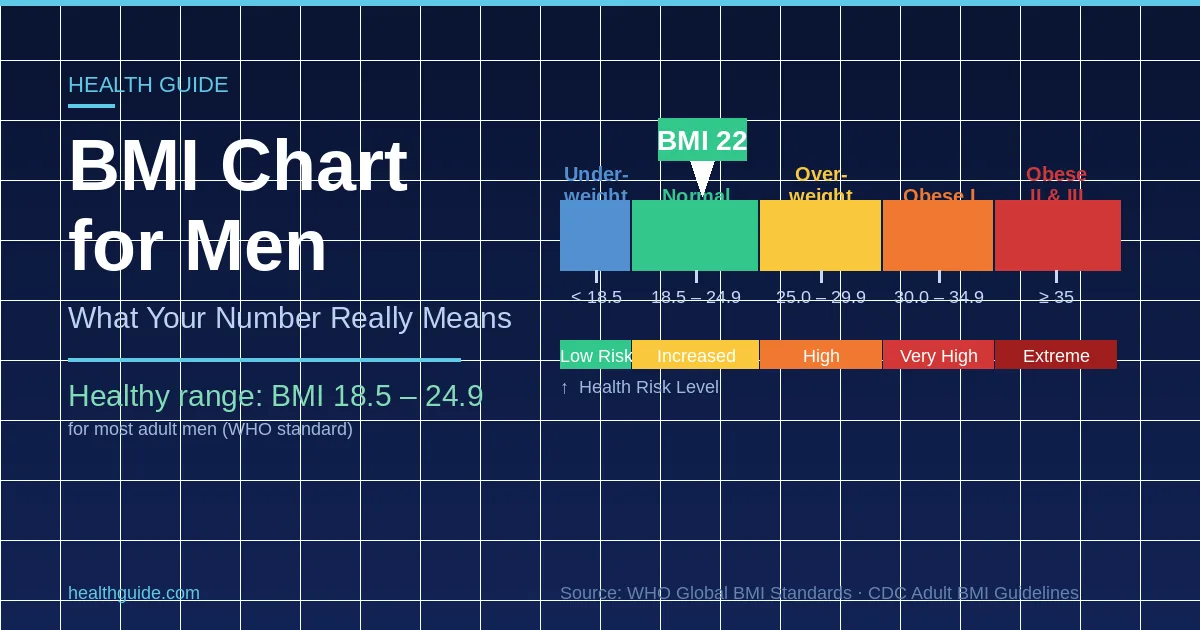
A healthy BMI for men sits between 18.5 and 24.9. Below that range signals underweight; above 25 signals overweight or obesity, with risk rising progressively through three obesity classes.
Standard WHO BMI Categories
| BMI Range | Category | Health Risk Level |
|---|---|---|
| Below 18.5 | Underweight | Moderate to High |
| 18.5 – 24.9 | Normal / Healthy Weight | Low |
| 25.0 – 29.9 | Overweight | Increased |
| 30.0 – 34.9 | Obese — Class I | High |
| 35.0 – 39.9 | Obese — Class II | Very High |
| 40.0 and above | Obese — Class III | Extremely High |
BMI Chart for Men by Age
Standard adult BMI categories apply from age 20 onward (CDC guidelines). However, body composition shifts naturally with age — older men carry more fat and less muscle at the same BMI as younger men, a process called sarcopenia. This changes what your BMI number implies clinically.
| Age Range | Standard Healthy BMI | Key Clinical Note |
|---|---|---|
| 20–34 | 18.5 – 24.9 | Muscle mass typically peaks; BMI most reliable here |
| 35–44 | 18.5 – 24.9 | Watch waist circumference as body composition begins shifting |
| 45–54 | 18.5 – 24.9 | Fat-to-muscle ratio often changes even at identical BMI |
| 55–64 | 18.5 – 24.9 | Body composition screening increasingly valuable alongside BMI |
| 65+ | 22.0 – 27.0 | Research supports a slightly higher healthy range |
A 2016 analysis published in The Lancet — drawing on data from nearly 4 million adults across 32 countries — found that men over 65 with a BMI between 24 and 27 had lower all-cause mortality than those in the standard “normal” 18.5–24.9 range. This is sometimes called the “obesity paradox” in older adults and remains an active area of clinical research.
What Does Each BMI Category Actually Mean for Men’s Health?
Underweight (BMI Below 18.5)
A BMI under 18.5 indicates insufficient body mass for your height. In men, this is associated with nutritional deficiencies, weakened immune function, low testosterone, reduced bone density, and fertility problems.
According to the CDC, underweight affects approximately 1.5% of adult men in the United States — far less common than overweight or obesity, but no less serious when present.
A very lean, highly muscular man can occasionally measure below 18.5 despite good health — context, as always, matters.
Clinical guidance: A doctor should rule out underlying causes including thyroid dysfunction, malabsorption disorders, or disordered eating. A registered dietitian can build a structured plan for healthy weight gain.
Normal / Healthy Weight (BMI 18.5–24.9)
This is the range associated with the lowest risk of weight-related chronic disease for most adult men. Men in this category show lower rates of type 2 diabetes, cardiovascular disease, hypertension, and several cancers compared to those above or below this range.
One critical caveat: a normal BMI does not equal optimal health. A man with a BMI of 23.5 but high visceral fat — the metabolically active fat stored deep inside the abdominal cavity — can still carry significant cardiometabolic risk. This is why waist circumference is increasingly measured alongside BMI in clinical settings.
Overweight (BMI 25.0–29.9)
Roughly 34% of adult men in the United States fall into this category, making it the most common BMI range for American men. Overweight status is linked to higher risk of hypertension, insulin resistance, sleep apnea, and joint loading — but absolute risk depends heavily on fat distribution and fitness level.
The important exception for muscular men: A man who is 5’11” with 205 lbs of lean muscle will show a BMI of approximately 28.6 — technically “overweight” — despite exceptional body composition. This is one of BMI’s most significant and well-documented blind spots.
Research published in the Journal of the American Medical Association (Flegal et al., 2005) controversially found that moderate overweight was associated with fewer deaths from some causes than normal weight in large population samples — a finding that underscores BMI’s limits as a standalone clinical tool.
Obese Class I (BMI 30.0–34.9)
At this level, risk of chronic disease increases substantially and measurably. Type 2 diabetes risk rises sharply, cardiovascular strain becomes clinically significant, and men commonly report joint pain, sleep disruption, and reduced energy. The CDC reports that approximately 36% of U.S. adult men are classified as obese (BMI ≥ 30).
Behavioral intervention — structured nutrition changes, progressive exercise, and sleep optimization — is typically the first-line treatment at this level.
Obese Class II (BMI 35.0–39.9) and Class III (BMI ≥ 40)
These ranges carry high to extremely high health risk across all major disease categories. Men in Class II and III obesity have significantly elevated rates of metabolic syndrome, nonalcoholic fatty liver disease, certain cancers (including colorectal and kidney), and premature mortality.
Bariatric surgery is evaluated as an option at BMI ≥ 35 with obesity-related comorbidities, or BMI ≥ 40 without. According to the American Society for Metabolic and Bariatric Surgery, over 250,000 bariatric procedures are performed annually in the U.S.
Why BMI Misses Critical Information for Men
BMI is a useful population-level screening tool, but it has four specific limitations that are especially important for men.
1. It Cannot Distinguish Muscle from Fat
BMI measures total weight relative to height. A 200 lb professional rugby player and a 200 lb sedentary office worker can share an identical BMI while having vastly different health profiles. This is not a flaw in the formula — it is simply the boundary of what the formula was designed to do.
2. Visceral Fat Is Invisible to BMI
Where you store fat matters more than how much you weigh. Visceral fat — stored around the liver, pancreas, and intestines — drives metabolic dysfunction at lower quantities than subcutaneous fat. Two men with identical BMIs of 27 can have completely different visceral fat loads and entirely different cardiovascular risk profiles.
A waist circumference over 40 inches (102 cm) in men is independently associated with elevated cardiometabolic risk, regardless of BMI category.
3. Age and Ethnicity Shift the Thresholds
Research published in JAMA Internal Medicine (2011) found that South Asian men face significantly higher metabolic risk at lower BMI thresholds than men of European descent. The WHO has published separate guidelines for Asian populations, with overweight beginning at BMI 23 and obesity at BMI 27.5 — lower than the standard global thresholds.
4. It Ignores Cardiorespiratory Fitness
Research from the Cooper Institute across multiple large cohort studies consistently shows that “fit and fat” men outlive “thin and unfit” men. High cardiorespiratory fitness independently reduces mortality risk even in the obese BMI range — something BMI alone will never capture.
Better Measures to Use Alongside BMI
| Measure | How to Calculate | Healthy Threshold for Men |
|---|---|---|
| Waist Circumference | Measure at navel level, after normal exhale | Under 94 cm / 37 inches |
| Waist-to-Height Ratio | Waist (cm) ÷ Height (cm) | Below 0.50 |
| Body Fat % (DEXA) | Measured by scan | 8–19% (varies by age) |
| Fasting Glucose | Blood test | Under 100 mg/dL |
| VO₂ Max | Graded exercise test or estimate | Age-dependent; higher is better |
How to Use Your BMI Result: A Step-by-Step Approach
- Calculate accurately. Use the CDC or WHO online BMI calculator. Measure height barefoot, weight without clothes, first thing in the morning.
- Identify your category. Locate your BMI in the WHO table above. Note whether you are borderline or clearly within a range.
- Measure your waist. Use a soft measuring tape at navel level after a normal exhale. Compare against the 94 cm and 102 cm thresholds.
- Calculate waist-to-height ratio. Divide waist circumference by height (both in centimetres). A ratio above 0.50 signals increased central fat accumulation.
- Review your blood markers. Request a basic metabolic panel from your doctor if you haven’t had one in the past year. Fasting glucose, triglycerides, and HDL cholesterol are the most telling for metabolic health.
- Assess your fitness. Even a rough gauge — how far can you run in 12 minutes, how many push-ups can you complete — gives context BMI cannot. Improving cardiovascular fitness independently lowers mortality risk at nearly any BMI.
- Talk to your doctor with the full picture. Bring your BMI, your waist measurement, and your blood results. If your BMI and your physical appearance don’t align — particularly if you are muscular — ask about a DEXA body composition scan. These are increasingly accessible and relatively affordable.
5 BMI Myths Men Still Believe
Myth 1: “If my BMI is normal, I’m healthy.”
Not automatically. A man with BMI 23 but a sedentary lifestyle, high fasting blood sugar, and a waist over 38 inches is at real metabolic risk. BMI is a starting point, not a clean bill of health.
Myth 2: “BMI doesn’t apply to muscular men at all.”
It applies — it just needs context. A BMI of 27 driven by lean muscle mass is clinically different from a BMI of 27 driven by fat. The number matters; so does what is behind it.
Myth 3: “I need to hit a specific target BMI number.”
BMI ranges are population-level tools, not personal targets. Your physician sets your goals based on your full clinical picture — blood markers, fitness, family history, and health history — not a chart alone.
Myth 4: “Obese BMI automatically means poor health.”
Research on metabolically healthy obesity shows a subset of people with high BMI have normal blood pressure, blood sugar, and lipid profiles. This does not mean obesity is safe long-term — studies show it frequently progresses to metabolic dysfunction — but it confirms that health is multidimensional.
Myth 5: “BMI is outdated and useless.”
BMI remains one of the most cost-effective, globally consistent population screening tools available. It consistently predicts disease risk at the population level. It is imperfect — no single metric is not — but dismissing it entirely misses its legitimate clinical utility when used appropriately.
Frequently Asked Questions
What is a good BMI for men?
For most adult men, a BMI between 18.5 and 24.9 is considered healthy by WHO and CDC standards. Men over 65 may benefit from a slightly higher range — around 22 to 27 — based on studies showing lower mortality in that zone. Always interpret BMI alongside waist circumference and basic blood markers for a complete picture.
Is BMI accurate for muscular men?
Not reliably as a standalone measure. BMI cannot distinguish muscle from fat. Men who strength train regularly often show BMIs in the overweight range (25–29.9) despite low body fat percentages. For muscular men, body fat percentage measured via DEXA scan or hydrostatic weighing gives far more accurate health information than BMI alone.
What BMI is considered obese for men?
A BMI of 30 or above is classified as obese by WHO standards. This is divided into Class I (30–34.9), Class II (35–39.9), and Class III or severe obesity (40 and above). Each class carries progressively higher risk of type 2 diabetes, cardiovascular disease, and all-cause mortality.
Does BMI change with age for men?
The standard categories apply from age 20 onward. However, body composition shifts with age — men naturally gain fat and lose muscle over time, even at the same BMI. For men over 65, some clinical research supports a slightly higher healthy BMI range of 22–27. Body composition assessment becomes increasingly important with age.
What waist size is healthy for a man?
A waist circumference under 94 cm (37 inches) is considered low risk. Between 94 and 102 cm (37–40 inches) represents increased cardiometabolic risk. Above 102 cm (40 inches) is high risk — independently of BMI. This single measurement is one of the most practical and predictive tools men can use to monitor health between doctor visits.
Can you have a normal BMI but still be unhealthy?
Yes. This is often called “normal weight obesity” or being “skinny fat” — carrying excess body fat at a normal BMI due to low muscle mass. Studies estimate this pattern affects 20–30% of people classified as normal weight. Blood markers, body fat percentage, and fitness levels reveal what height and weight alone cannot.
How often should men check their BMI?
For most healthy men, checking BMI once or twice a year as part of an annual health review is sufficient. BMI is most meaningful when tracked as a trend over months and years, not as a one-time verdict. A shift of 2 or more BMI points over a short period warrants a conversation with your doctor.
What should I do if my BMI is too high?
Start with a conversation with your physician — not a crash diet. Evidence supports sustainable lifestyle changes: reducing processed food intake, increasing physical activity (both resistance training and cardiovascular exercise), improving sleep quality, and managing chronic stress. A 5–10% reduction in body weight produces measurable improvements in blood pressure, blood sugar, and cholesterol in most men.
Conclusion
Your BMI number is a starting point, not a sentence.
For most men, a BMI between 18.5 and 24.9 represents the lowest-risk zone — but what matters most is what is driving that number. A muscular man at BMI 27 and a sedentary man at BMI 23 are not in the same health position, and treating them identically is where BMI falls short.
Use your BMI alongside your waist circumference, a basic blood panel, and an honest look at your fitness level. Together, those four pieces give you the full picture that no single number can.
Your action step: If you have not had a basic health panel in the past year, book one this week. Know your fasting glucose, your blood pressure, and your waist circumference. Those three data points, combined with your BMI, tell you vastly more than any chart alone ever could.
Stay informed and ahead of the game—our power reads deliver the wisdom you truly need.