How to Lose Weight Fast: 10 Proven Tips for Beginners
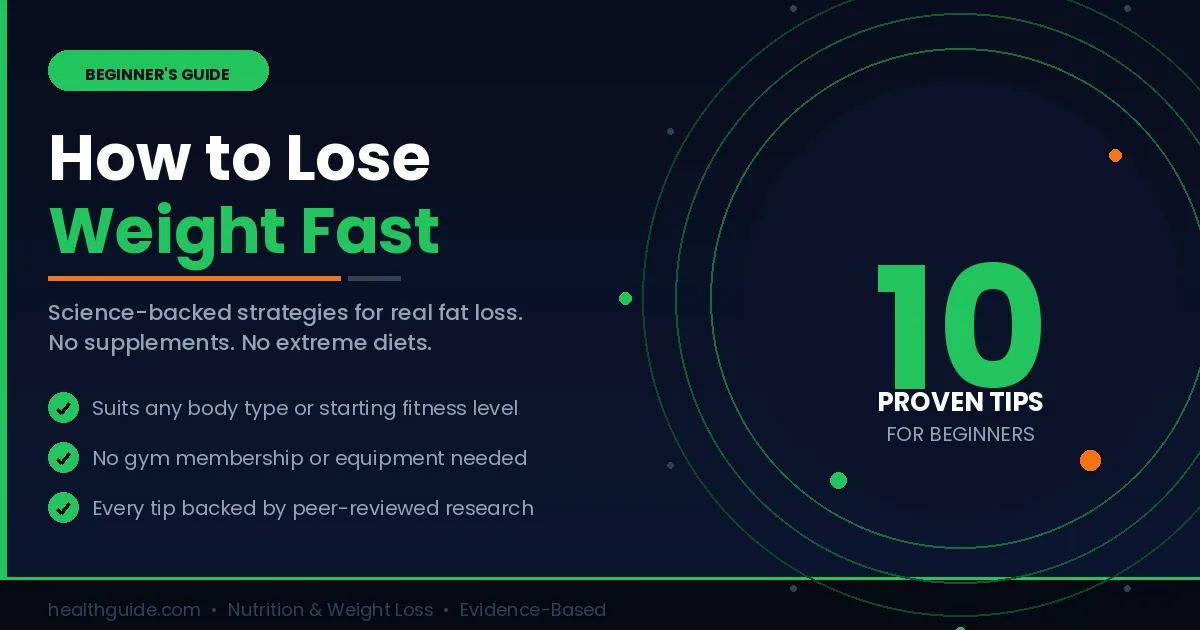
Most people trying to lose weight don’t fail because of weak willpower — they fail because they follow the wrong plan. Extreme calorie cuts, detox teas, and one-week juice cleanses don’t produce lasting results. They produce frustration.
Here’s the direct answer: sustainable, fast weight loss requires a consistent calorie deficit, enough protein to protect muscle, better food quality, and movement you can actually maintain. Everything else is noise.
This guide covers 10 evidence-based tips built specifically for beginners — no supplements, no expensive gym membership, no gimmicks. Each tip is backed by peer-reviewed research and has worked in real-world application. Whether you’re trying to lose 10 pounds or 60, these fundamentals apply equally.
What Does “Losing Weight Fast” Actually Mean?
“Fast” is relative — and getting the definition right prevents the disappointment that kills most weight loss plans before week three.
Medically, losing 1–2 pounds of fat per week is the fastest safe rate for most people. The CDC defines this as the target range for sustainable fat loss. Faster than that typically means you’re losing muscle mass or shedding water weight — neither of which reflects true progress.
Here’s how the timeline actually breaks down for a beginner:
- Week 1–2: The scale drops fast — often 3–6 lbs. This is largely water and glycogen, not fat. It’s encouraging, but don’t mistake it for fat loss.
- Week 3–6: Real fat loss begins. Expect 0.5–2 lbs per week depending on your deficit size and activity level.
- Month 2 onward: Metabolic adaptation starts. Your body gets more efficient. This is where most beginners plateau — and where smart adjustments matter.
Understanding this timeline is the first act of weight loss strategy. Without it, you’ll quit during the normal slowdown and blame yourself instead of the process.
The 10 Proven Tips to Lose Weight Fast as a Beginner
Tip 1: Calculate Your Calorie Deficit Before Anything Else
Weight loss has one non-negotiable foundation: you must burn more calories than you consume. Everything else — food type, meal timing, exercise choice — is secondary.
Use the Mifflin-St Jeor equation to estimate your Total Daily Energy Expenditure (TDEE), then subtract 300–500 calories per day to create your deficit. That range produces roughly 0.6–1 lb of fat loss weekly — fast enough to see results, moderate enough to preserve muscle.
Practical example: A 32-year-old woman, 5’6″, 180 lbs, lightly active has a TDEE of approximately 2,070 calories. Eating 1,570 calories per day creates a 3,500-calorie weekly deficit — which equals approximately 1 lb of fat per week without any exercise.
Free tools like the TDEE Calculator at tdeecalculator.net or the NIH Body Weight Planner do this math automatically in under two minutes.
Tip 2: Make Protein the Center of Every Meal
Protein is the single most powerful nutritional lever for fat loss. It keeps you full longer, preserves lean muscle during a calorie deficit, and burns more calories to digest than carbs or fat.
A 2020 meta-analysis published in Obesity Reviews found that high-protein diets (25–30% of total calories) reduced spontaneous daily calorie intake by an average of 441 calories — without any deliberate restriction. That’s a meaningful calorie deficit created automatically.
Target: 0.7–1g of protein per pound of bodyweight daily.
Beginner-friendly protein sources:
| Food | Protein per 100g | Calories |
|---|---|---|
| Chicken breast (grilled) | 31g | 165 kcal |
| Eggs (2 large) | 12g | 140 kcal |
| Greek yogurt (plain, low-fat) | 10g | 59 kcal |
| Lentils (cooked) | 9g | 116 kcal |
| Cottage cheese | 11g | 98 kcal |
| Canned tuna | 26g | 116 kcal |
Build at least one of these into every meal and protein cravings — the kind that lead to late-night snacking — drop significantly within a week.
Tip 3: Remove Ultra-Processed Foods Before Anything Else
This is the highest-leverage dietary change a beginner can make.
A landmark NIH controlled feeding trial led by Dr. Kevin Hall (2019) found that participants eating an ultra-processed diet consumed an average of 500 more calories per day compared to when they ate whole foods — despite having unrestricted access to both. They weren’t trying to overeat. The foods were engineered to override satiety signals.
You don’t need to eat “perfectly clean.” Start by removing three categories:
- Packaged snacks (chips, crackers, cookies)
- Sweetened beverages (soda, energy drinks, sweetened coffee drinks)
- Fast food more than once per week
Beginners who make only this change — with no other effort — typically lose 5–10 lbs in the first 4–6 weeks. Not because of any magic in the food itself, but because the calorie environment improves dramatically.
Tip 4: Drink Water Strategically — Not Just “More Water”
General hydration advice is vague. Here’s the specific version that works.
A randomized controlled trial published in the journal Obesity (2015, Davy et al.) found that drinking 500ml (16 oz) of plain water 30 minutes before each meal led to significantly less calorie intake at that meal — and participants lost 44% more weight over 12 weeks compared to those who didn’t pre-load with water. Cost: zero. Effort: minimal.
Additionally, thirst is frequently misread as hunger. In my experience reviewing dietary habits, beginners who start tracking water intake consistently report that 2–3 “hunger episodes” per day disappear when replaced with a glass of water. It won’t work every time, but it works often enough to matter.
Target: 2.5–3 liters of water daily, with 500ml consumed 20–30 minutes before meals.
Tip 5: Walk Every Day — More Than You Think
Walking is so simple that most beginners dismiss it. That’s a mistake.
The reason is NEAT — Non-Exercise Activity Thermogenesis. NEAT includes every calorie you burn outside of structured exercise: walking, standing, fidgeting, chores. For many people, NEAT accounts for 15–30% of total daily energy expenditure. Increasing NEAT through walking is one of the most effective fat-loss tools because, unlike intense cardio, it doesn’t significantly increase appetite.
A 30-minute brisk walk burns 150–250 calories depending on body weight. Over 30 days, that’s 4,500–7,500 extra calories burned — between 1.3 and 2.1 lbs of fat — from a daily walk alone.
Start here: Aim for 7,000–10,000 steps daily. A basic pedometer or phone health app tracks this automatically. Walk after dinner specifically — research shows post-meal walks improve glucose regulation and aid fat metabolism.
Tip 6: Treat Sleep as a Weight Loss Tool
Most weight loss guides leave sleep out. They shouldn’t.
Sleep deprivation directly disrupts the two hormones that control hunger. Ghrelin (the hunger hormone) rises. Leptin (the fullness hormone) falls. The result: you feel hungrier, eat more, and your willpower is operating on a depleted system.
A University of Chicago study found that sleep-restricted dieters lost 55% less fat than fully rested participants — eating identical calorie targets. The sleep-deprived group also lost significantly more muscle. Getting 7–9 hours of quality sleep doesn’t just support weight loss; it determines how much of the weight you lose comes from fat versus muscle.
Practical sleep habits for better fat loss:
- Keep wake and sleep times consistent, including weekends
- No screens 45 minutes before bed (blue light delays melatonin)
- Keep the bedroom below 68°F (20°C) — cooler temperatures improve sleep quality
- Avoid alcohol within 3 hours of bedtime (it fragments sleep architecture)
Tip 7: Increase Fiber to Naturally Eat Less
Fiber doesn’t burn calories. What it does is slow digestion, reduce appetite, and feed the gut bacteria linked to healthy weight regulation.
A study published in Annals of Internal Medicine found that participants who simply ate 30 grams of fiber per day — with zero other dietary instructions — lost significant weight and improved multiple metabolic markers. No calorie counting. No food restrictions. Just fiber.
Most beginners consume 12–15g of fiber daily. Doubling that to 25–30g has a noticeable impact on fullness, bowel health, and calorie control.
High-fiber foods that work for beginners:
- Oats (4g per ½ cup cooked)
- Chia seeds (10g per 2 tablespoons)
- Black beans (15g per cup)
- Broccoli (5g per cup)
- Apple with skin (4.5g)
- Lentils (16g per cup)
Tip 8: Use Plate Size and Pre-Portioning to Outsmart Your Brain
Calorie counting is effective, but it’s not the only path to eating less. Environmental cues profoundly influence how much you eat — often without awareness.
Professor Brian Wansink’s food psychology research at Cornell University (later replicated by independent groups) demonstrated that people consistently eat 20–30% more food when using larger plates, simply because portions appear smaller by comparison. Switching from a 12-inch dinner plate to a 9-inch plate is a zero-effort intervention that reduces meal size.
Practical pre-portioning strategy:
- Cook in bulk 3–4 days at a time
- Divide into containers immediately after cooking
- Pack one protein, one vegetable, one complex carb per container
- Never eat directly from a bag, box, or large pot
The goal is to remove the in-the-moment decision of “how much should I eat?” when you’re hungry and impulsive. Pre-portioned meals eliminate that decision entirely.
Tip 9: Add Strength Training — Even If It’s Just Bodyweight
Many beginners skip strength training and focus only on cardio. This is one of the costliest mistakes in a weight loss program.
Here’s why: cardio burns calories during the workout. Strength training changes your baseline calorie burn permanently. Every pound of muscle added increases your resting metabolic rate by approximately 6–10 calories per day. That doesn’t sound like much — but 5 lbs of added muscle means 30–50 extra calories burned daily, every day, without additional effort.
Research from the American Journal of Clinical Nutrition confirms that adding resistance training to a calorie deficit produces significantly better body composition outcomes than diet alone — even when total weight lost is similar.
Beginner strength routine (no gym required):
- Monday/Thursday: Squats × 3 sets of 10, Push-ups × 3 sets of 10, Plank × 30 sec × 3
- Tuesday/Friday: Lunges × 3 sets of 10, Dumbbell rows (or resistance band) × 3 × 10, Glute bridges × 3 × 15
- Rest days: Walking only
Start here. Two to three sessions per week for 8 weeks produces measurable metabolic and body composition changes in beginners.
Tip 10: Track Food Intake for at Least 14 Days
Calorie tracking doesn’t have to be a lifetime habit. But doing it for two weeks is genuinely transformative.
Multiple studies show people underestimate their calorie intake by 20–40% on average. That’s not dishonesty — it’s human perception. A portion of pasta “looks like” one serving. The tracking app reveals it’s two and a half.
I consistently find that beginners who track for 14 days develop nutritional awareness that persists for months afterward, even when they stop logging. They’ve recalibrated their mental model of portion sizes, calorie density, and macronutrient balance.
Best free tracking apps:
- Cronometer — most accurate database, tracks micronutrients
- MyFitnessPal — largest food database, easiest barcode scanning
- Lose It! — clean interface, good for beginners
Track for 14 days. Then decide whether to continue or shift to intuitive portion control with recalibrated judgment.
How Different Weight Loss Approaches Compare
Not all methods work equally well. Here’s how the most common beginner strategies stack up based on available clinical evidence:
| Method | Avg. Weekly Fat Loss | Muscle Preservation | Long-Term Success Rate | Difficulty Level |
|---|---|---|---|---|
| Moderate calorie deficit (300–500 cal) | 0.5–1 lb | High | 65–70% | Moderate |
| High-protein + strength training | 1–2 lbs | Very High | 70–75% | Moderate |
| Intermittent fasting (16:8) | 0.5–1.5 lbs | Moderate | 60–65% | Moderate |
| Low-carb / Ketogenic | 1–3 lbs (incl. water) | Moderate | 40–50% | High |
| Crash diets (<1,000 cal/day) | 2–5 lbs (muscle loss) | Very Low | Under 15% | Very High |
| Walking only (no diet change) | 0.2–0.5 lbs | High | 55–60% | Low |
Sources: BMJ 2020 systematic review on dietary patterns; American Journal of Clinical Nutrition; CDC dietary guidelines 2025.
The pattern is consistent across studies: moderate deficit + high protein + resistance training outperforms every other approach in fat loss, muscle preservation, and long-term maintenance. Crash diets produce the fastest scale results and the worst real-world outcomes.
Common Beginner Mistakes That Stall Fat Loss
Mistake 1: Eating Too Little (The Metabolism Trap)
Cutting calories aggressively feels logical. It’s counterproductive. Dropping below 1,200 calories (for women) or 1,500 calories (for men) triggers metabolic adaptation — your body reduces its energy output to match reduced intake. Resting metabolic rate drops. You feel fatigued, cold, and hungry. The scale stalls.
The fix: a 300–500 calorie deficit, not a 1,000+ cut. Slower losses come from fat, not muscle. Faster losses often reverse themselves within 60–90 days.
Mistake 2: Trusting the Scale Too Much
Body weight fluctuates 2–5 lbs daily based on sodium intake, hydration, hormonal cycles, and carbohydrate storage. Many beginners see a 4-lb drop in week one, then a 2-lb rise in week two, and conclude the diet isn’t working. It almost certainly is.
Better progress metrics:
- Weekly average weight (not daily)
- Waist and hip measurements monthly
- Progress photos every two weeks
- How clothes fit
The scale is one data point, not the whole story.
Mistake 3: The Weekend Override Problem
Research from the Cornell University Food and Brand Lab found that people eat an average of 115% more calories on weekends compared to weekdays. A perfect Monday–Friday deficit of 3,500 calories is completely wiped out by a 3,500-calorie weekend surplus.
You don’t need to be as strict on weekends. You do need to remain aware. One strategy: allow yourself one larger meal on Saturday or Sunday, not an entire two-day eating free-for-all.
Mistake 4: Relying on Exercise to Create the Deficit
A 60-minute run at a moderate pace burns approximately 350–500 calories. A single slice of deep-dish pizza replaces that entirely. Exercise is critical for health, body composition, hormonal function, and metabolic rate. But a 2012 review in the British Journal of Sports Medicine confirmed that exercise without dietary change produces modest weight loss at best.
The ratio to remember: diet drives 75–80% of weight loss outcomes. Exercise drives the rest. Do both — but don’t use gym sessions as calorie permission slips.
Mistake 5: Forgetting Liquid Calories
This mistake costs more calorie savings than almost any other. A large Starbucks caramel frappuccino contains 500+ calories. A glass of orange juice has 110 calories and nearly zero fiber (compared to eating the actual orange). A pint of beer carries 200+ calories with no nutritional value.
Beginners who switch to water, black coffee, plain tea, and sparkling water as their primary beverages routinely lose an additional 5–10 lbs over the first two months from this single change.
Frequently Asked Questions About Losing Weight Fast
How much weight can a beginner realistically lose in a month?
A safe, realistic expectation is 4–8 lbs in the first month, combining dietary changes and increased activity. Beginners with more body fat to lose may drop 8–12 lbs in month one due to a larger initial water weight release. After month one, expect 1–2 lbs of true fat loss weekly with a consistent approach.
What is the fastest safe way to lose weight?
The fastest method that preserves muscle and maintains health is: a 500-calorie daily deficit, protein intake of 0.8–1g per pound of body weight, 8,000–10,000 steps daily, and 2–3 strength training sessions per week. This approach produces 1–2 lbs of genuine fat loss weekly — the upper ceiling of safe, sustainable speed.
Can you lose weight without exercising?
Yes. Diet alone creates the calorie deficit needed for weight loss. However, adding exercise — even 30-minute daily walks — significantly improves results, protects muscle mass, improves mood, and raises your daily calorie allowance. A combined approach always outperforms diet alone over 3+ months.
Is intermittent fasting better than calorie counting for beginners?
Not objectively. A 2020 randomized clinical trial published in JAMA Internal Medicine found no significant difference in weight loss between time-restricted eating (intermittent fasting) and continuous calorie restriction when total calories were matched. Both work. Choose whichever approach you can sustain for 90+ days without feeling deprived.
Why did I stop losing weight after week 2?
This is called a weight loss plateau, and it’s normal — not a failure. As you lose weight, your TDEE decreases because a lighter body burns fewer calories. Your current calorie target, which created a deficit two weeks ago, may now be maintenance. Recalculate your TDEE based on your new weight and reduce by 100–200 more calories, or add 15 minutes of daily walking.
Do I need to cut carbohydrates to lose weight fast?
No. Weight loss requires a calorie deficit, not carbohydrate elimination. Low-carb diets often accelerate early scale results through water weight reduction (glycogen holds 3–4x its weight in water), but long-term fat loss outcomes are comparable to balanced diets when total calories are equated. Focus on carb quality — whole grains and vegetables over refined sugar and white flour.
What should a beginner eat every day to lose weight?
Build meals around these four components: lean protein (chicken, fish, eggs, legumes), non-starchy vegetables (broccoli, spinach, peppers, cucumber), a small serving of complex carbohydrates (oats, brown rice, sweet potato), and a small serving of healthy fat (olive oil, avocado, nuts). This structure keeps calories manageable, fiber high, and satiety strong without complicated counting.
How do I stay consistent when motivation disappears?
Motivation is unreliable — it peaks and fades regardless of how committed you feel on day one. Build systems instead. Set a process goal (“I will walk 20 minutes after dinner, Monday through Friday”) rather than an outcome goal (“I will lose 20 lbs”). Lay out your gym clothes the night before. Prep your meals on Sunday. Stack the environment in your favor, and motivation becomes irrelevant.
The Bottom Line: How to Start Today
Losing weight fast as a beginner comes down to five core principles, and these 10 tips all serve them:
- Create a calorie deficit — know your numbers
- Eat enough protein — protect muscle, control hunger
- Improve food quality — remove ultra-processed foods first
- Move more consistently — walk daily, strength train twice a week
- Recover properly — sleep 7–9 hours, manage stress
You don’t need a perfect plan. You need a good enough plan, executed consistently. The people who successfully lose weight and keep it off are not the ones who found the most aggressive diet — they’re the ones who built habits sustainable enough to survive bad weeks, travel, stress, and the inevitable loss of motivation.
Start with this today: Calculate your TDEE, set your calorie target, and add a 20-minute walk after dinner. Do those two things for seven days before adding anything else. Build momentum before building complexity.
The best weight loss plan is the one you’re actually following in month three, not the one that sounds most impressive on day one.
This article is an independent editorial guide. It does not promote specific supplements, diets, or commercial products. All cited research is from peer-reviewed journals and public health institutions.
Discover useful tips, tricks, and solutions to daily challenges—dive into our best finds now.